The AI takeover won't be linear

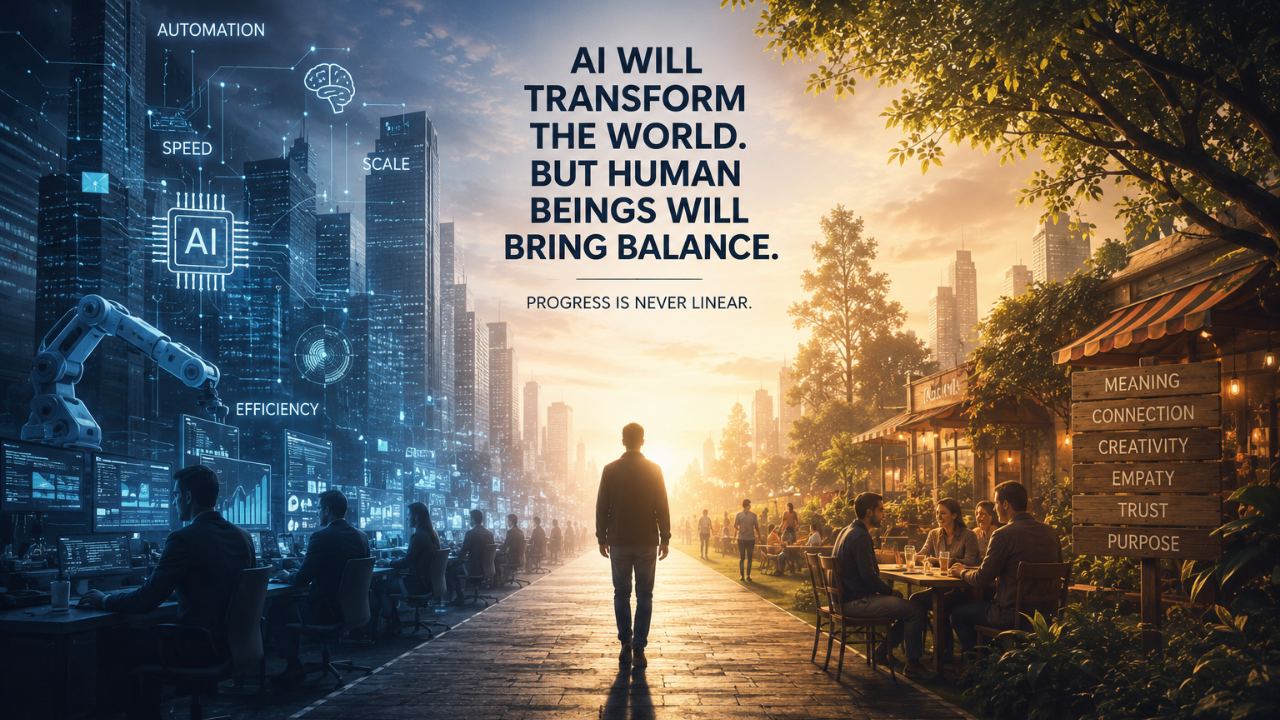
The world comes back
Innovations in this world bring two things: one excitement, and the other nervousness. Every revolution has brought the world with era transformations - rise of personal computers, internet boom, cloud revolution - everything has brought perspectives which constantly change the way the world operates, and after a while, stability becomes the new normal. That stability is what gives rise to possibilities. Innovation has a downside too - it brings amongst the people nervousness as to what will happen when things change. Nobody likes change. Nobody likes to talk about it, and nobody sees it in the same way - some adapt, some defend, and some try to protect the legacy.
AI is one revolution that is touching masses, this one is bigger than any of the revolutions I mentioned before. This is because its not just changing the infrastructure behind, its changing the relevance of degrees, jobs, and the ideal ways of working. This clearly means that this change is affecting the "human" aspect - and this human aspect is what gives it a very complex angle. Its very difficult to predict what will happen, how will it happen and the exact timelines. In his blog, Bill Gates outlines the way AI revolution is different from others and that the world is highly underprepared for it.
I do agree with him, but at the same time, I think there is a minor aspect to this change that everyone is missing. We tend to believe this change will be linear and constant from now on.
In my own lifetime, I have seen things coming back because people first tend to move towards change, however, later realize that something important got missed.
See below examples:
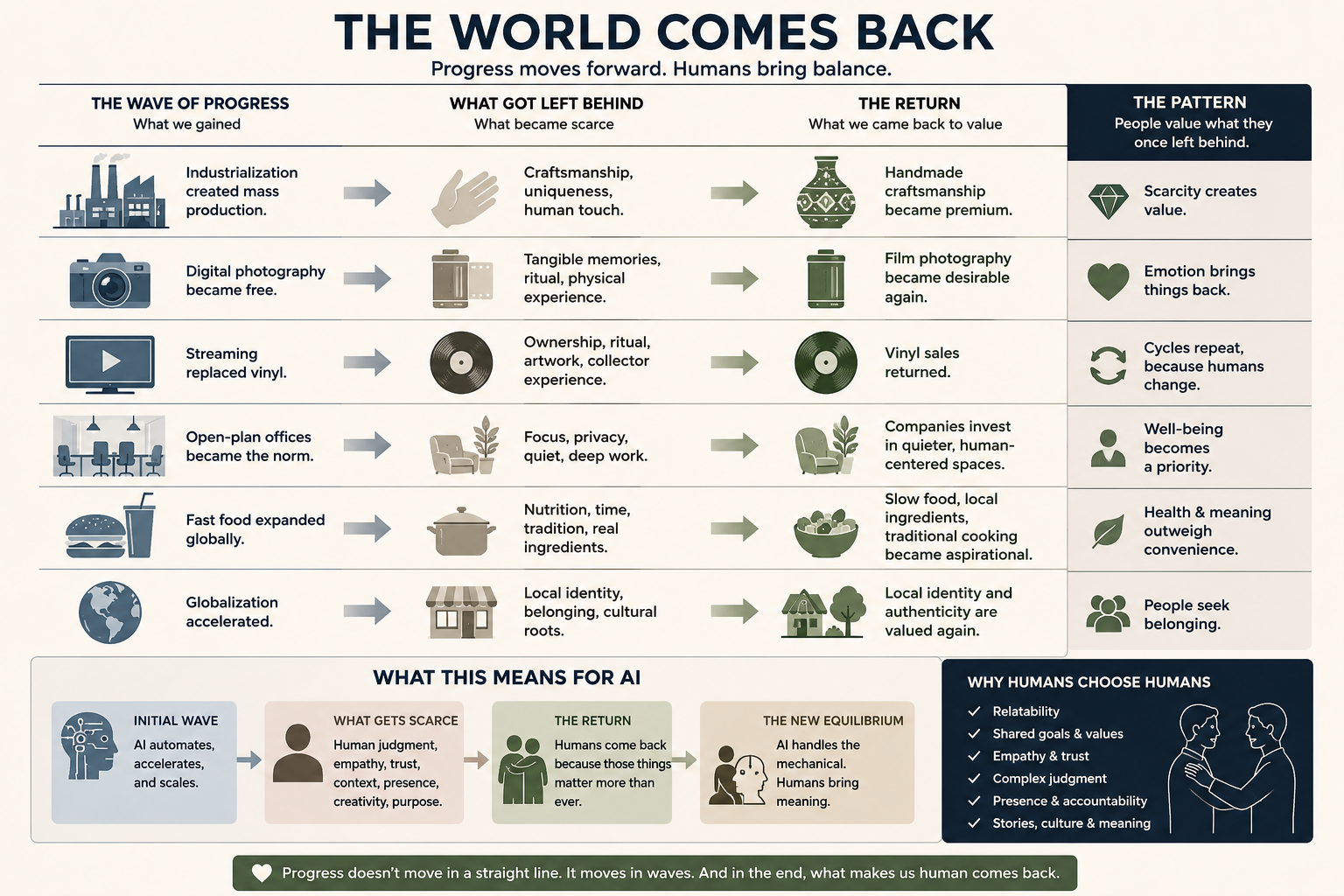
- Industrialization created mass production. People later paid premiums for handmade craftsmanship.
- Digital photography became free. Film photography became desirable again.
- Streaming replaced vinyl. Vinyl sales returned.
- Open-plan offices became the norm. Companies now spend money creating quieter, more human-centered spaces.
- Fast food expanded globally. Slow food, local ingredients, and traditional cooking became aspirational.
- Globalization accelerated. Consumers increasingly value local identity and authenticity.
Do you see something common in above examples? People started to value what they left behind. In AI's case, its about humans :) I believe humans are talking about how they can leave humans behind. And the reality is that initially humans will be left behind - jobs will be displaced, new jobs will be created and everything will be re-thought. However, it wont be as simple and the stable ways of working in AI era will bring the human aspect back. But first, we need to understand why are humans really valued, and why would humans chose humans over AI?
Why are humans valued?
Humans are valued not because of just the skills they entail. That is rarely the case. Humans value humans because of relatability, sense of common goals, and the touch which cannot otherwise be created from mechanical arms. Imagine a world wherein the doctors are not humans, AI is solving patients' cases. While AI can and will develop empathy over time (read this blog on how can we measure AI system's empathy), however, humans will always know that AI is not human. Therefore, humans will come back to humans in so many different ways.
One example from my life: in consulting world, do you think onshore consultants are doing a job that offshore consultants cannot do? Onshore consultants are not rocket scientists and I clearly don't think that they are just paid 3x because of their time zones. They are paid because they are close to their stakeholders, act as key problem solvers, and get things done. Stakeholders don't want to let their people go in many circumstances even if technically it is possible and they are replaceable. Its because humans need humans - their empathy, understanding, cognitive thought process, actual on ground experience and the ways to reliably get things done. That is the basis for our human existence and evolution.
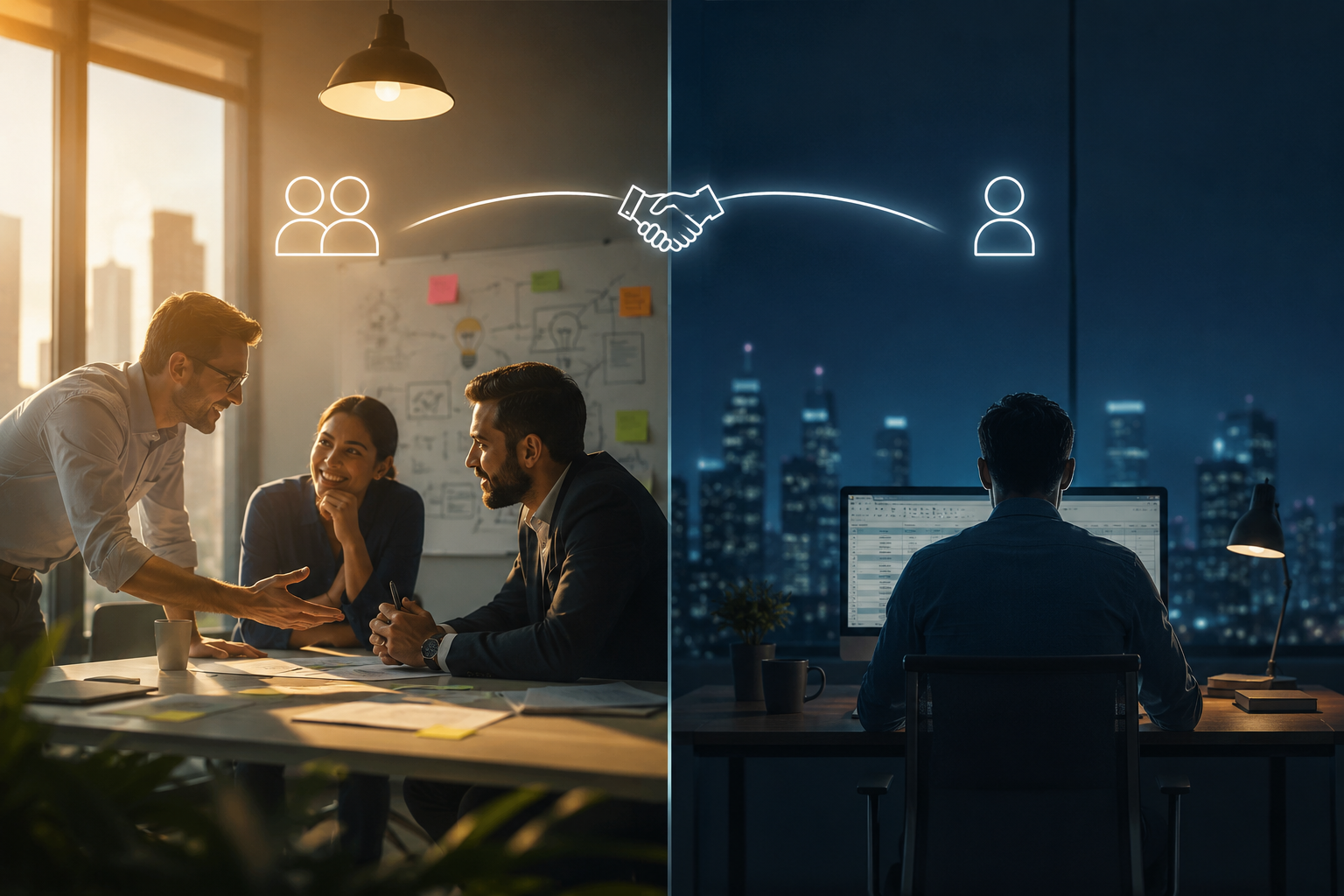
This does not mean AI would not take over our jobs, what this means is that progress is not as simplified and linear as we might imagine. History is testament to this fact, and AI era would have complex waves of disruptions, realizations and corrections.
Progress is rarely linear
As with the examples before, there is one example that always sticks with me. Its very relatable. In the 20th century, the world went berserk with fast food. Fast food industry took over and the world followed. This enabled speed, efficiency, scale and standardization.
After observing the grave effects of fast food on the world, we are now moving towards slow cooked food, because that helps maintain food's nutrition, and provides a better quality health.
Progress solves a problem. Then the solution creates a new scarcity. And humans eventually begin valuing what the previous wave of progress made scarce.
Whilst humans do appreciate the speed and scale, we also get attracted towards craftmanship, artisanal cheese, pasta, and handmade breads.
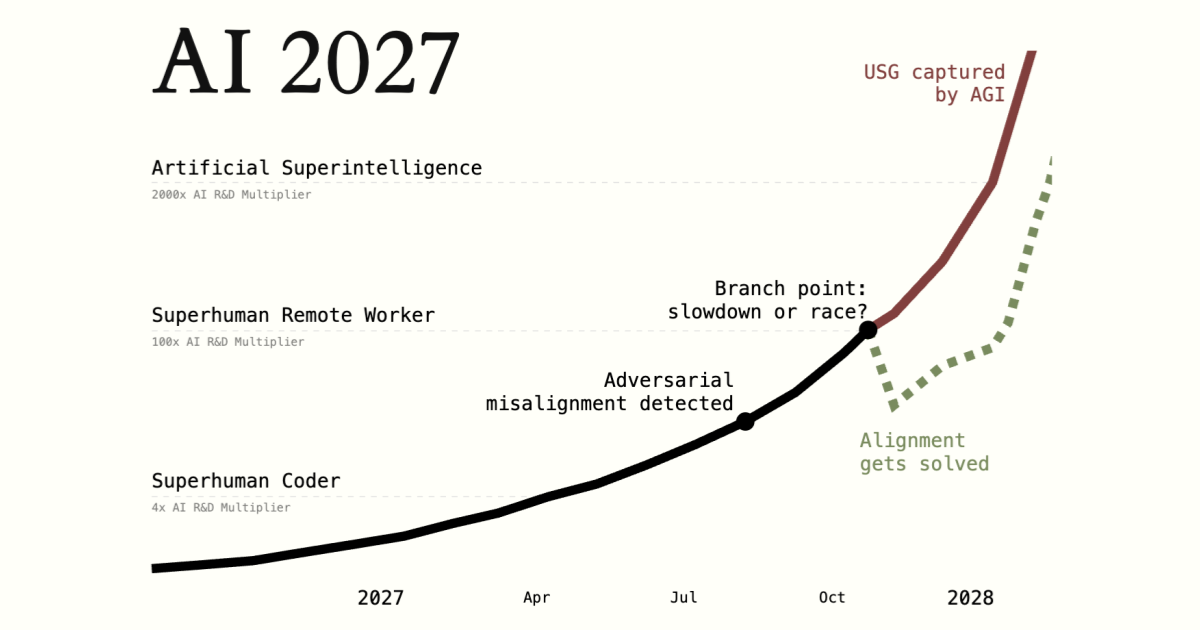
With AI, there are multiple schools of thoughts as to how future looks like. I don't have an answer. AI 2027 is a predictive scenario written by former OpenAI researcher Daniel Kokotajlo, forecasting expert Eli Lifland, AI policy experts Thomas Larsen and Romeo Dean, and blogger Scott Alexander. They outline a concrete, quantitative timeline forecasting how Artificial General Intelligence (AGI) and superintelligence might emerge by 2027 and its potential global impact. Mckinsey also predicted that by 2030, AI will require 14% of the workers to pivot their fields entirely.
However, we need to be cautious with these predictions because statistics can be used to form and break human notions, and sometimes create narratives. There is almost always a hidden truth hiding behind these predictions. The "Rehire" Financial Trap: Gartner warns that sweeping AI-driven layoffs can backfire. They predict that up to 30% of roles displaced by AI will eventually be rehired by 2029 at a much higher cost due to recruitment premiums and the collapse of internal talent pipelines.
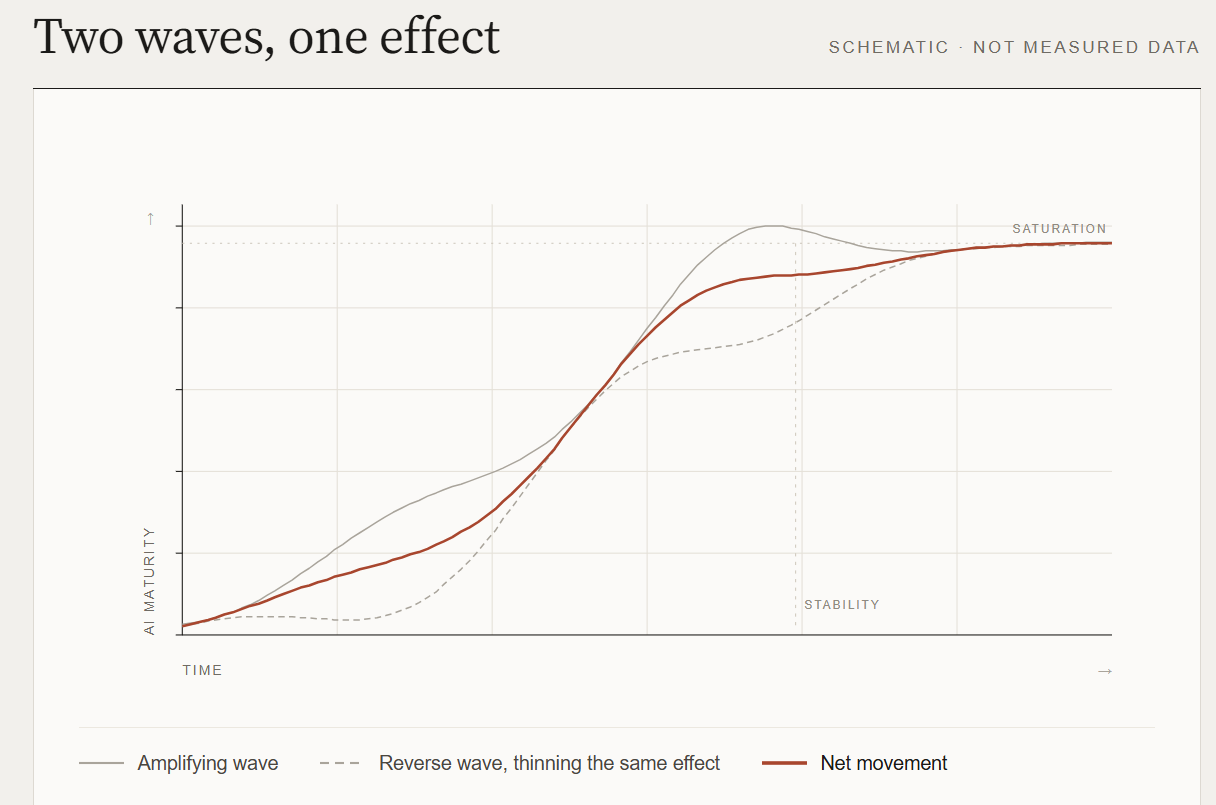
Therefore, we should not overly simplify. Rather we should be cautious with our strategies. There will be a wave amplifying one effect, and there will be a reverse wave thinning the same effect. Undoubtedly, AI will transform us entirely, and that is the reason we have been obsessed (sometimes overly) with it for the past 3-5 years. All I am saying is that we should be vary of the magnitude of this effect and not make rash assumptions.
Why humans behave the way they behave
AI is a technological revolution. But we may or may not accept it just yet - that it has more to do with human psychology than we might think. AI revolution is a blend of many past revolutions - because we never had that big of a disruption yet. Rise of personal computers comes close but AI challenges us even more because it directly questions the existence of many things.
There are two theories which I believe come close to explaining my thoughts well.
1) Self-Determination Theory
Deci and Ryan's Self-Determination Theory argues that people have three fundamental psychological needs: autonomy, competence and relatedness. In other words, humans don't just care about what gets done. We care about:
- Did I choose it?
- Did I become good at something?
- Did I do it with/for people who matter?
You could have an AI produce the perfect presentation in 10 seconds. But the human may still want to: think → struggle → debate → create → persuade → accomplish. Humans value agency and participation.
2) Humans are organically nostalgic.
According to National Geographic, nostalgia is strongly associated with social connection, self-continuity, meaning and even optimism. A 2023 review describes nostalgia as a highly social emotion that can strengthen feelings of connection and meaning. So when someone builds a house with their grandparents' architecture, they may not simply be saying:
"I like old style rustic houses."
They might think that but they may unconsciously be saying:
"I want my present to feel connected to something that came before me."
AI will also make humans nostalgic and its not about the resistance for change, its more about the human touch once things start to get automated and humans start to get challenged on multiple fronts.
Therefore, humans will not just sit back and relax when AI delivers the job, because they want to be part of the puzzle too. A big part of the puzzle. The identify of humans will be lost if they are out of the picture, so the world will come back from the peaks of the AI revolution, not to slower the progress, but to make the progress well governed, organic and sustainable.
What does "stable" look like?
We all know by now that AI operating model will look very different than today because agents will take over a lot of mechanical work. However, companies are likely to make mistakes if they hurry - it wouldn't be as simple as reducing workforce just to show efficiency. This measure could backfire - I agree with Gartner.
Companies should think how they can re-use the workforce, pivot their employees to use them efficiently. Its important to think how AI can be use as an augmentation tool and how it complements humans in order to make good decisions. Imagine two companies with very similar AI tech stack - state of the art - fast systems, which are able to produce very good outputs and are agentic in nature. Which company will turn out to be better? It would be the company which is able to bridge the gap between AI outputs and very good decisions. For this, we need strong human leaders who can validate, trust, understand the vision and give concrete direction to the company. This is what stable looks like. By no means, I am making any prediction. This is just a thought process. For predictions, consulting companies are more than enough 😄
References
https://www.gatesnotes.com/a-turbulent-ai-era-and-critical-choices-to-make
https://www.gartner.com/en/articles/ai-workforce-costs
 AnyWhichWay