Transitioning from Narrow AI

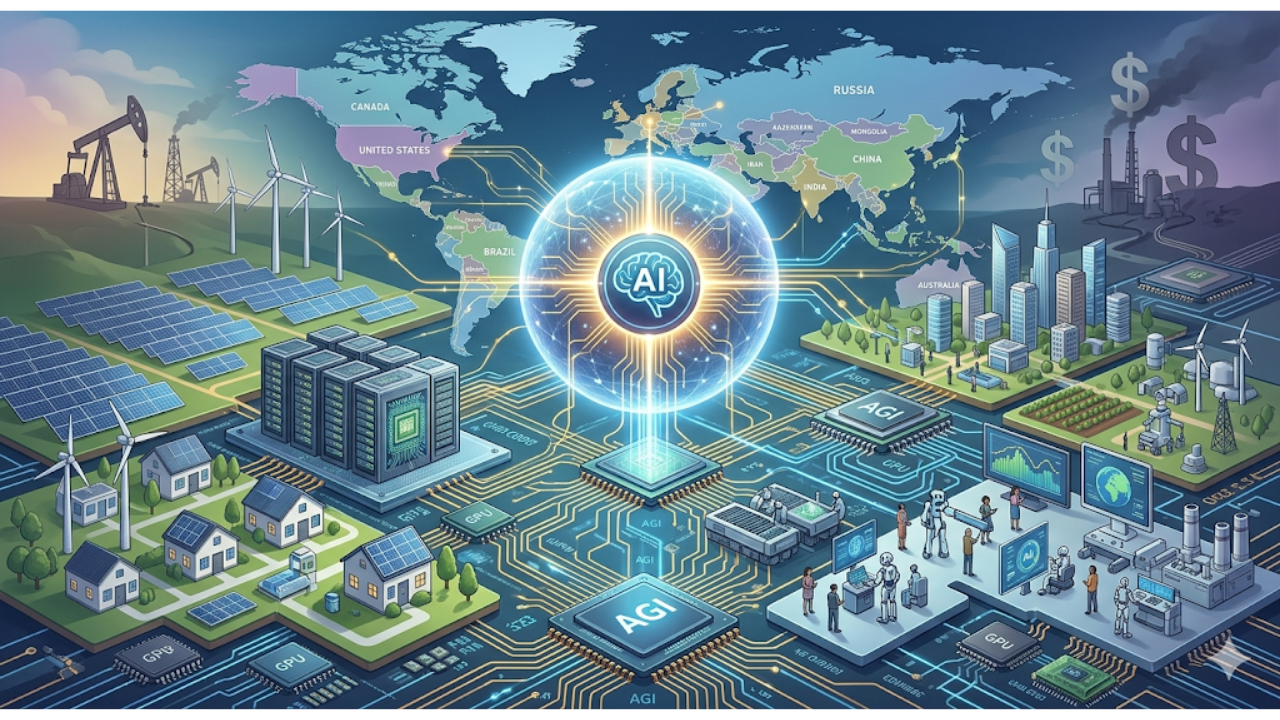
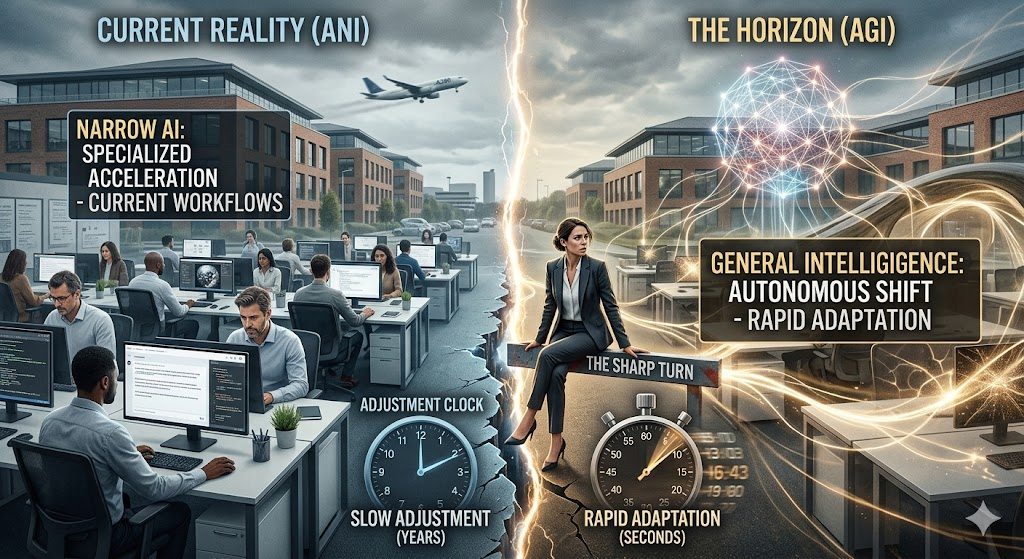
How is the ideology of AGI slowly changing the fiction into reality? Sci-fi movies have always provoked us to think beyond our reality. Some of the reality came to life in the past few years - with LLMs, image and video models changing the way we think and work. These models have been making us question about current workflows and ways of working - and been bringing out some difficult questions many leaders want to avoid. One thing we all have been planning and contemplating though is "Adjustment". Adjustment to new era, and once everything matures, how would the new world and jew jobs look like. I just wonder that this is the case when narrow AI has taken over our lives. With AGI - Artificial General Intelligence, things will take further turn, and our world would not look the same again.
What if we don't get time for adjustment? What if we have to adapt quickly? The rate of AI enablement is changing more sharply vs what we had ever anticipated. To understand this further, lets deep dive into the concept of AGI.
What is AGI?
Artificial General Intelligence or AGI is a branch of AI, which is inter-disciplinary, can implement the learnings of one branch into others, can sense emotions and act accordingly. That is why - its name "general intelligence". We often refer to neural network as something that tries to mimic the brain, and that forms the basis of deep learning.
However, human brain is the most complex thing that we know, and designing machines as or more complex than that is not going to be easy and for that reason, AGI is super hard. Humans have emotions, intelligence, motivation, and sense and feel, and that is why the human race has evolved much quicker, faster, and today, we are designing things no one could have imagined even 20 years ago. AGI takes things to next level as it brings the computational power and intelligence of systems to a degree where it matches humans across domains and disciplines.
The way AGI needs to be developed is to "reverse engineer" the brain.
AGI will not come in phases
The concept of neural networks first came in 20th century, and only a few years ago, we saw the maximum penetration of its application into our lives - through the likes of ChatGPT and now many other models and tools. Similarly, the work on AGI has been happening and it can be seen into action through a fragmented way across the world because it is not commoditized yet. However, sometime not too long from now, it will get into our lives and it might be possible that by then, we would not even have learnt the art of living in the era of narrow AI.
Some of us would still be learning to accept it, most of the organizations would still be curating themselves by that time, and only some would have learnt to embrace it.
AGI would enable us in unimaginable ways. Some of the examples:
- diagnose your illness, design your treatment, and explain it to you — switching fluidly between doctor, researcher, and communicator
- Scientific breakthroughs compressed from decades to months — drug discovery, climate solutions, materials science
- Personalized education that understands every student deeply and teaches anything to anyone
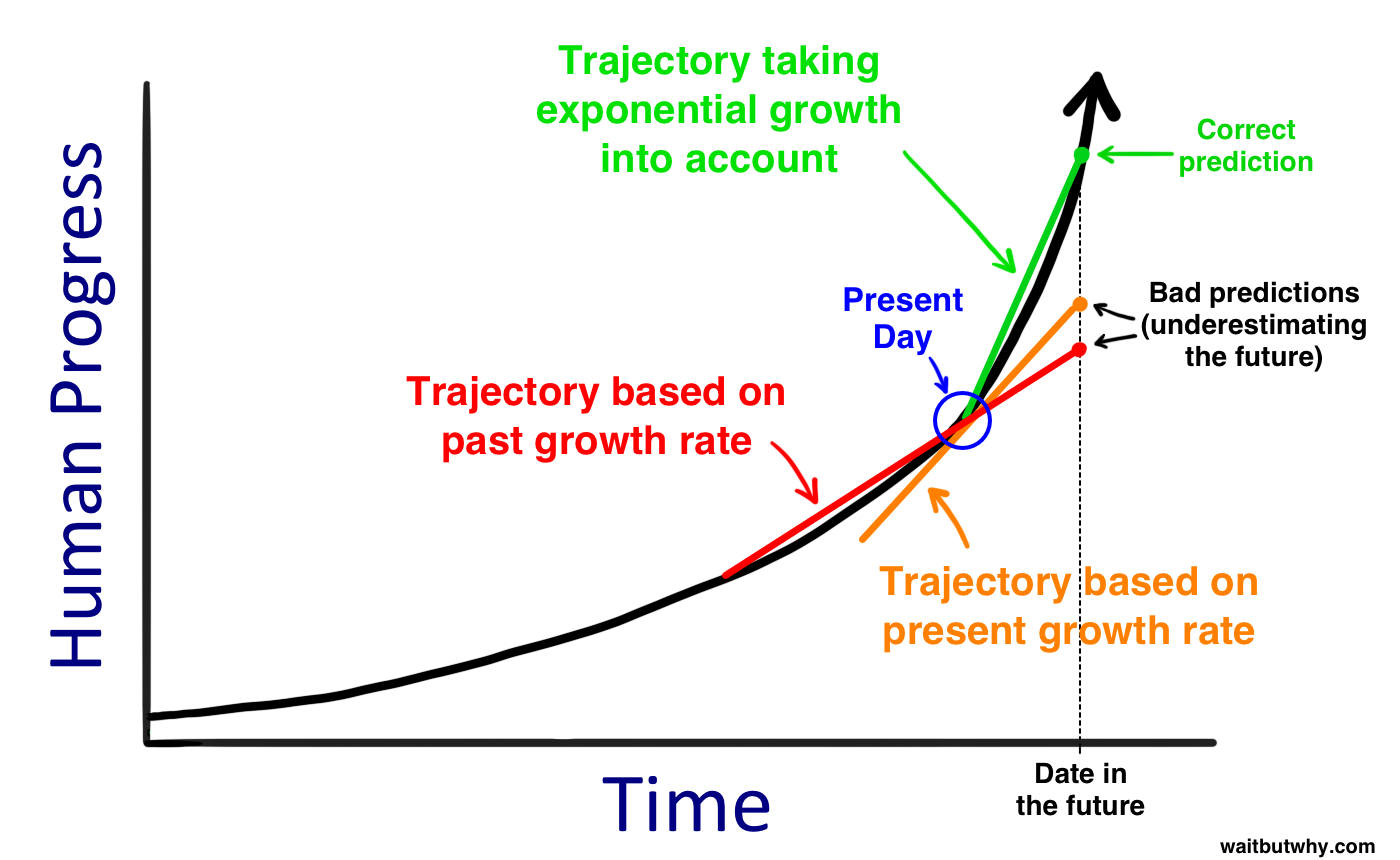
All of this is potentially possible but there is no timeline for it, but there are possibilities that it can start to happen within next decade. Technological progress in the world has always happened at an exponential rate, and not linear, and AGI would not be any different.
Where are we today?
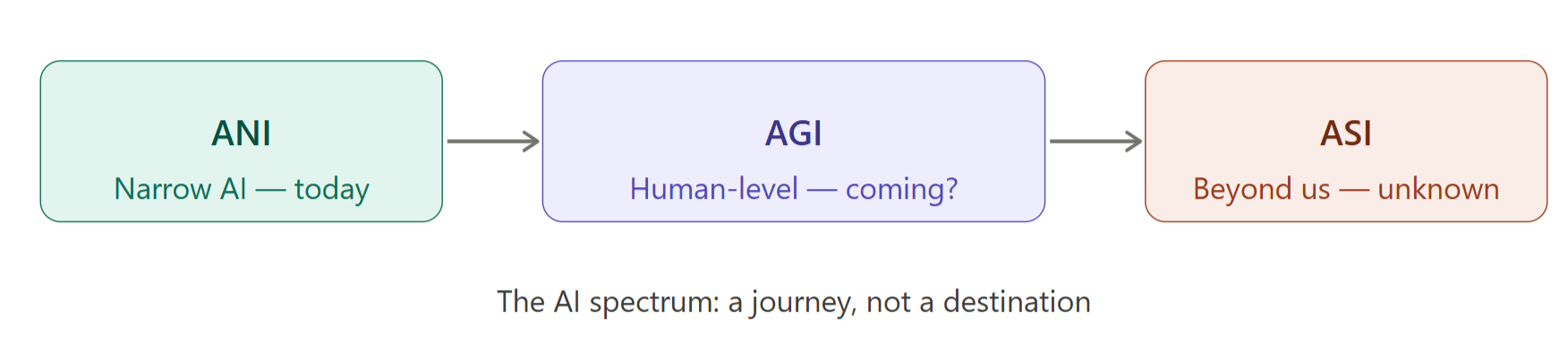
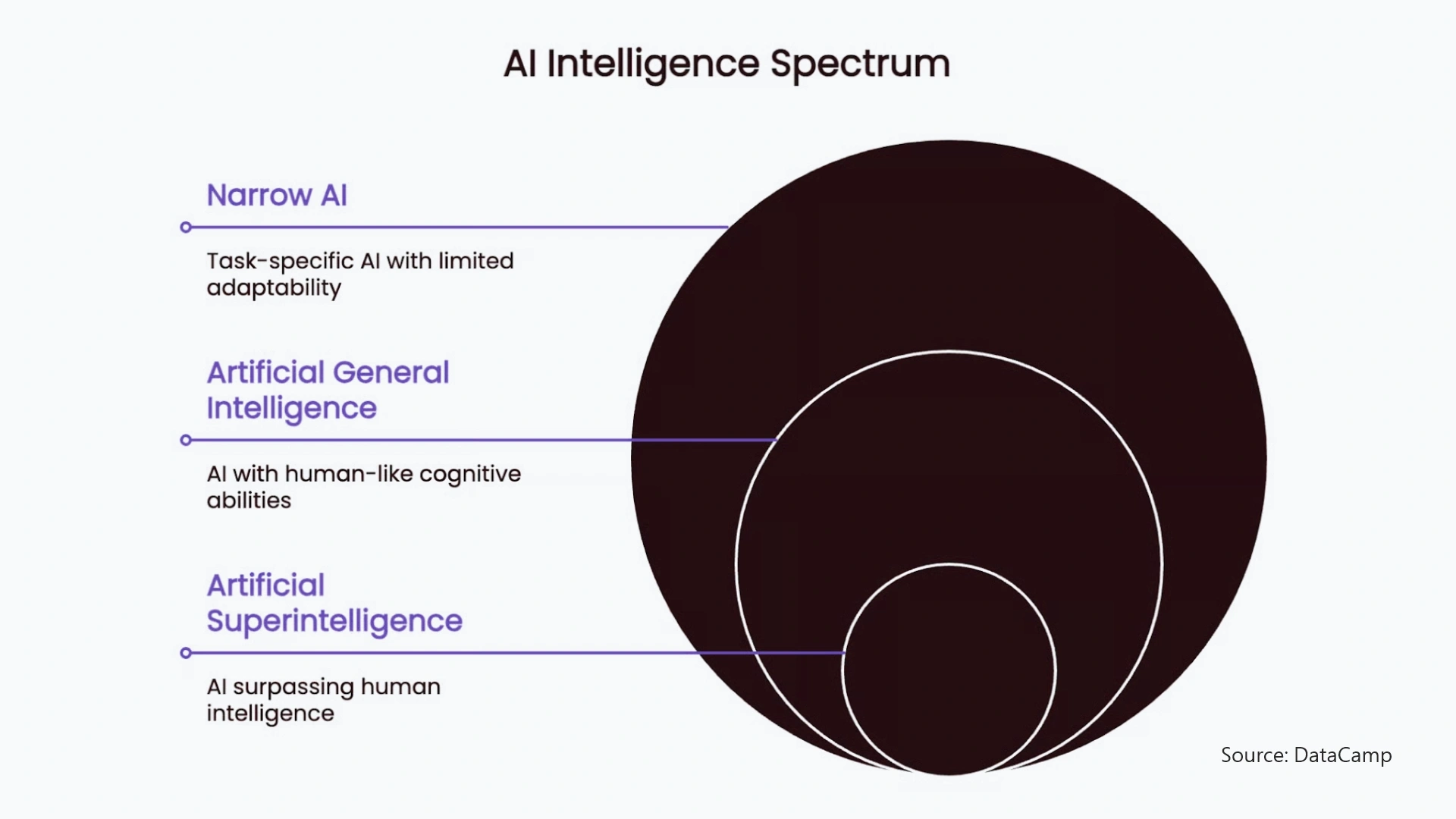
We are currently in the era of Artificial Narrow Intelligence (ANI). In ANI, specific models are trained for specific tasks. For ex: you might see Claude launching a model for healthcare, OpenAI's Codex, and Claude's Claude Code for coding respectively. Similarly, and Microsoft developed Copilot M365 for personal productivity. All these tools enable us to live in the world of agents, but agents are narrow in a way that they are trained for specific tasks to make a particular segment of our lives easier. Tech companies are now moving towards multi-agent systems which is truly one of the but not the only building blocks of AGI. Multi-agentic systems let multiple agents interact with one another and solve the problems of the humans' by utilizing the best agent for the job. That is where the concept of MCP - Model Context Protocol from Anthropic came in to enable a framework for multi-agent systems.
AGI is not narrow, it is broader than that and bring multi-agent system to a deeper horizon. It's not just many specialized agents working together — it's a single system that can reason, learn, and adapt across any domain, without needing to be trained for each task in advance.
There is another era beyond AGI - Artificial Super Intelligence (ASI) in which robot's thinking and complexity would be far beyond humans. AI would be able to think, feel, sense and scope like humans across multiple domains, mostly better than us.
During ASI era, AI would be able to take over our jobs, and it would not just be about getting enabled on AI, it would be about re-thinking the work that humans do. At that point, the question isn't whether AI can do your job - it's whether humans remain the primary decision-makers at all.
Again, every era is powerful and exciting, but at the same time, if not tightened up with the right regulations, poses risks. Humans are ruling the earth because of their intelligence, and when something competes with us in intelligence, we would need to evolve and adapt very fast. A good or bad thing is: ASI is a bit far ahead of us right now.
Impact of AGI
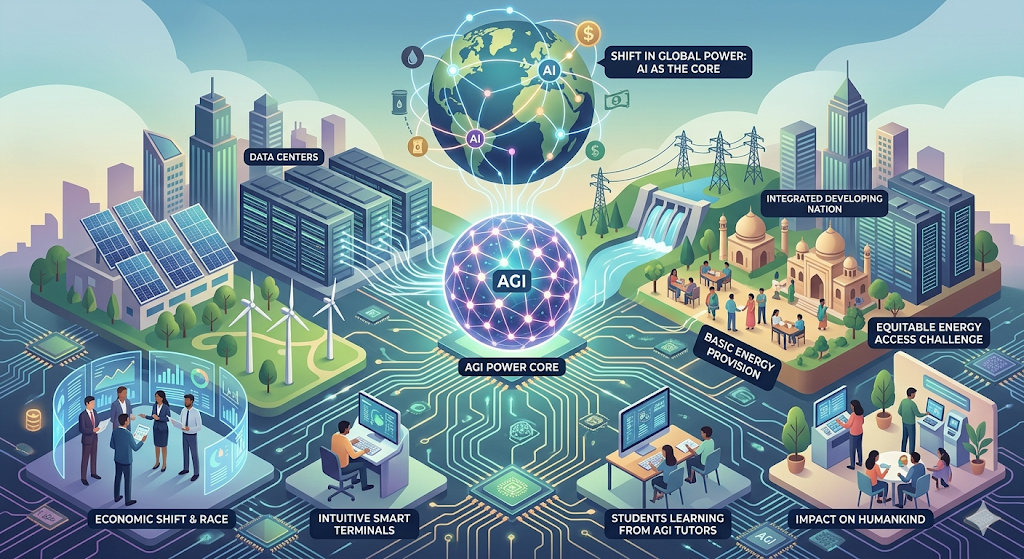
The impact of AGI can be broken down into f0llowing main parts:
1) Impact on humankind: The economy will shift dramatically with every country trying to become a part of this race. “I’d say I’m basically 70 to 80% there,” OpenAI co-founder and president Greg Brockman said, describing how close he believes we are to AGI. AI that can match or exceed human-level performance across virtually any intellectual task.
Currently, AI can do tasks better than humans but in fragmentation and we still await systems which will augment humans "generally".
2) Impact on energy needs: Currently, many developing countries such as India are still struggling to provide the energy for basic household throughout the country. As AGI matures, there will be heavy reliance on massive computational power, and that will necessitate the need for data centers, which will significantly increase the need for more energy.
3) Shift in power: For decades, power was concentrated on countries which have more oil, and then more dollar reserves. Then, in this century, everyone realized that Data is the new oil and companies which control data are very powerful. AGI would make AI as the center of power and that is why many countries are trying to take a lead and investing heavily. AI would be able to solve a lot of problems such as self-reliance, automation and scale and the country which is able to succeed in that would take a lead in shaping world order.
4) AI Infrastructure: Chips have made the news in this decade so much because AI needs GPUs and chips to train massive models with billions of neurons. That is why NVDIA and other chip manufacturers are now companies with market capitalization more than the GDP of most of the countries. Countries which benefit from the chip manufacturers own the system. This is very visible in the recent tensions between US-China.
Which companies are working on AGI actively?
All the companies such as OpenAI, Anthropic, Meta and xAI, which are working on developing large models are all actively working on AGI. But this race can be won by anyone, even small players. Its not just about developing cutting edge models, but it is also about:
- Partnering with companies working on scalable AI infrastructure (chips, data centers, etc.)
- Focusing on ethical AI
- Setting up robust governance frameworks
- Developing systems which are highly scalable and enterprise focused
I am excited about AGI, but at the same time I want to be prepared for it. While writing this blog, I got to learn about a lot of unprecedented research undertaken in this sector, but there is a lot more to know and learn. There are just endless possibilities!!
Reference
 Databricks Staff
https://openai.com/index/our-approach-to-the-model-spec/
 Datos Insights
 Bernhard Schaffrik
https://chatgpt.com/c/69becdd8-f5b4-832d-aeb3-b4f1377d0807
 Tim Urban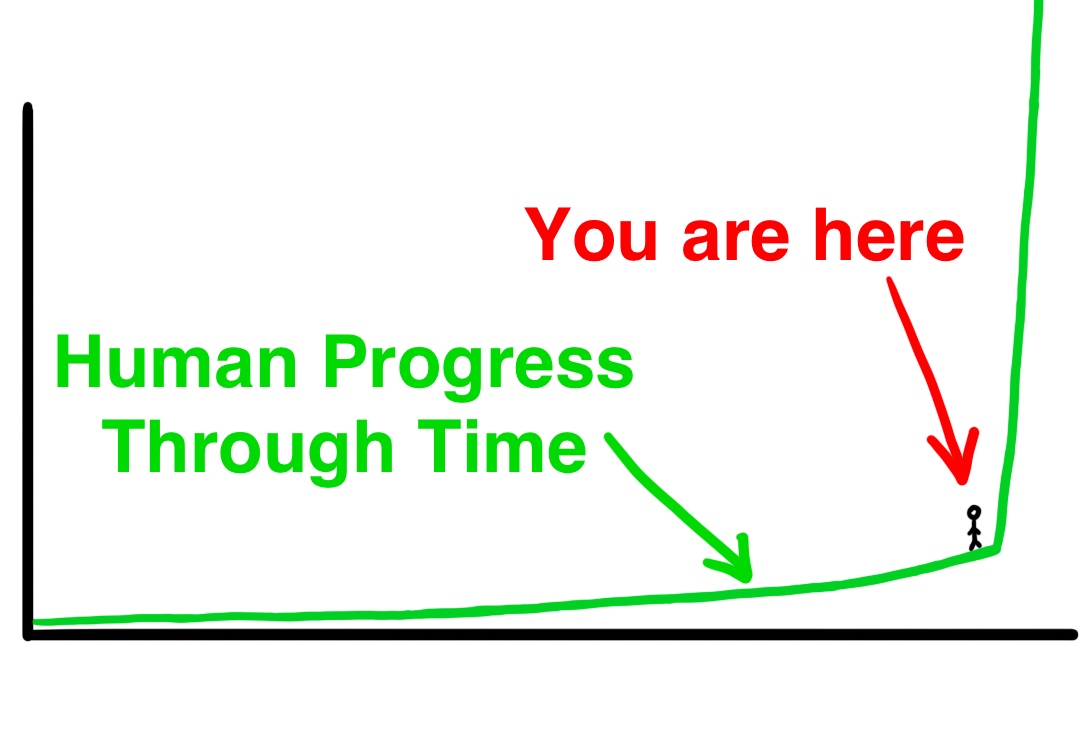
 United States Artificial Intelligence Institute (USAII®)
 Anca Dragan, Rohin Shah, Four Flynn and Shane Legg